
Burrito vs Taco vs Quesadilla: Key Differences

Burrito vs taco vs quesadilla sounds like a simple menu question until you're standing at the counter. All three are a tortilla with something inside, and that's about where the similarity ends.
We're Blue Burro, and our our menu carries all three, so here is how we explain the difference. Our short version: the burrito is a meal, the taco is a bite, and the quesadilla is a cheese delivery system.
Quick answerThe main difference between a burrito, a taco, and a quesadilla is how the tortilla is used. A burrito wraps a large flour tortilla around many fillings and seals it. A taco folds a small tortilla around one filling. A quesadilla melts cheese inside a folded tortilla on a griddle. |
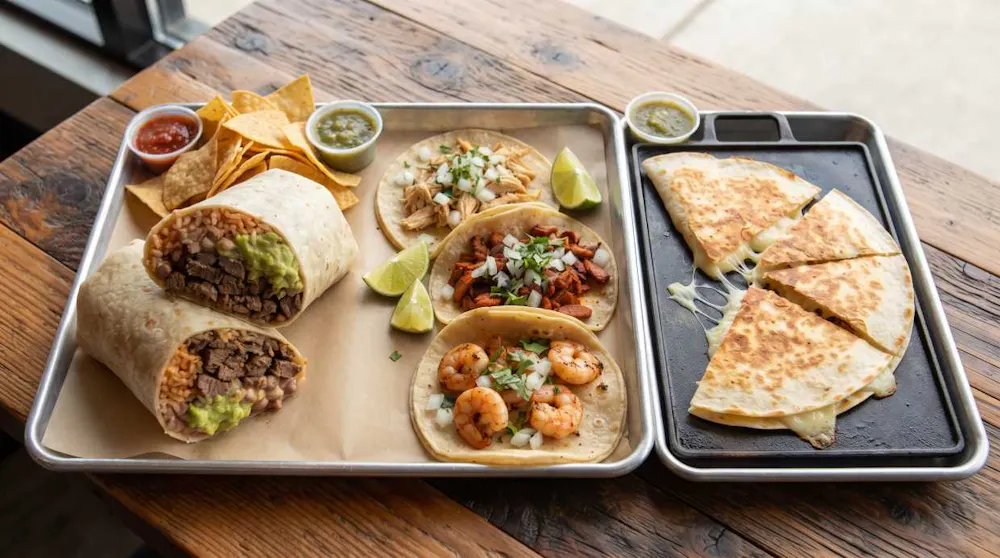
How do a burrito, taco, and quesadilla compare at a glance?
A burrito, taco, and quesadilla differ in tortilla, shape, portion, and when the filling meets the heat. This table puts the four biggest differences in one place.
| Feature | Burrito | Taco | Quesadilla | |
Tortilla | Large flour tortilla | Small corn or flour tortilla | Corn or flour tortilla | |
Shape |
| Folded or open | Folded in half or pressed between two tortillas | |
Portion | A full meal in one | Often ordered in threes | Bigger than a taco, often cut into wedges | |
Defining filling | Meat, rice and beans, and more | One main filling with simple toppings | Melted cheese |
Sources: the Wikipedia entries for taco and quesadilla, plus the Travels of BBQboy and Spanky food guide.
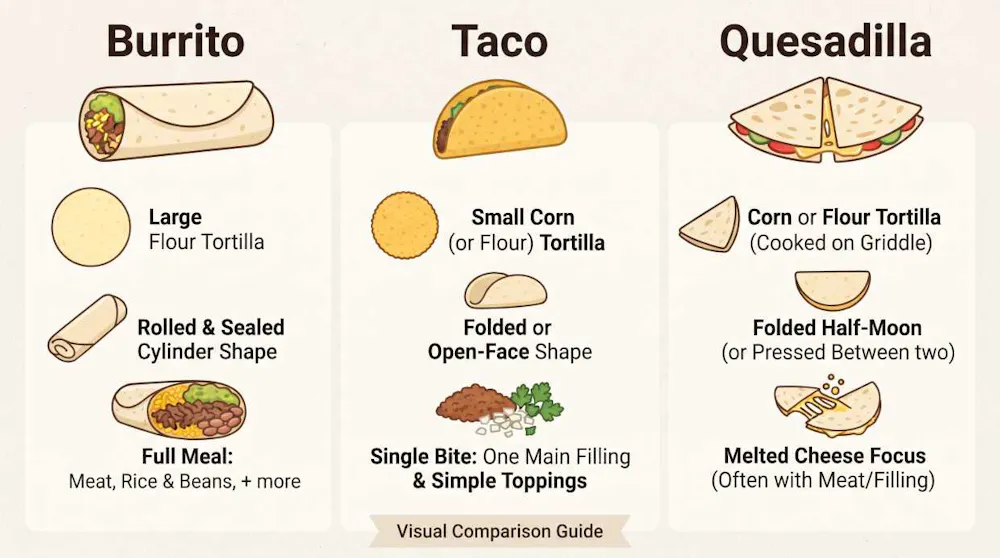
What is the difference between a burrito and a taco?
The difference between burrito and taco comes down to tortilla, shape, and portion. A taco uses a small, hand-sized tortilla folded around one filling, while a burrito uses a large flour tortilla rolled into a sealed cylinder around several.
Folded vs rolled is the visual giveaway. A taco leaves its filling showing along the top, and a burrito hides everything inside the wrap.
Geography explains the tortilla choice across Mexican cuisine. According to the BBQboy guide to Mexican food, northern Mexico leans on flour tortillas and the south on corn, and a corn tortilla would tear if you tried to roll a burrito.
Both are handheld food, but a burrito is a packed lunch and a taco is a single slider. For the full backstory of the rolled version, see our guide to what a burrito is.
Burrito vs taco size: how big is each one, really?
Burrito vs taco size is not a close contest. The BBQboy guide says three or four tacos usually fill you up, while one burrito is often a whole meal.
Our catering packs show the same math. The Build Your Own Taco pack comes with 60 corn tortillas and feeds 20 to 25 people, so plan on two or three tacos per guest. Our burrito pack holds 20 burritos and feeds 20 to 30, because burritos can be cut in half.
Feeding a group? Take a look at our burrito and taco catering packs.
Quesadilla vs burrito: what sets them apart?
In the burrito vs quesadilla comparison, cheese and cooking order are the dividing lines. A quesadilla is a tortilla folded in half, or two tortillas stacked, filled with cheese and cooked on a griddle until it melts, per Wikipedia.
The word itself means little cheesy thing, and the Skip foodwiki notes that quesadillas are often cut into wedges like a pizza while burritos are eaten handheld.
Cooking order matters most. A burrito gets cooked fillings added to a warm tortilla, then rolled. A quesadilla gets its cheese inside before it ever touches the heat, so the melted cheese glues the whole thing together.
In the Southwestern United States, a quesadilla works like a grilled cheese sandwich with a tortilla standing in for the bread.
Taco vs quesadilla: where do they overlap?
The difference between a taco and a quesadilla is when the filling meets the heat. Mexico City's Chilango magazine points out that a taco's tortilla and filling are usually warmed separately, while a quesadilla's filling must already be inside the tortilla when it goes on the fire.
Shape is the second clue. A quesadilla is nearly always folded in half, and a taco can be folded, rolled, or doubled up.
They do overlap in one spot. Mexico News Daily says the only quesadilla that resembles a taco is the comal version filled with stews, and even then the street-vendor tortilla is bigger and thicker.
Both are classic street food, which is part of why the arguments never end.
What cheese goes in a quesadilla? Oaxaca cheese, Monterey Jack, and more
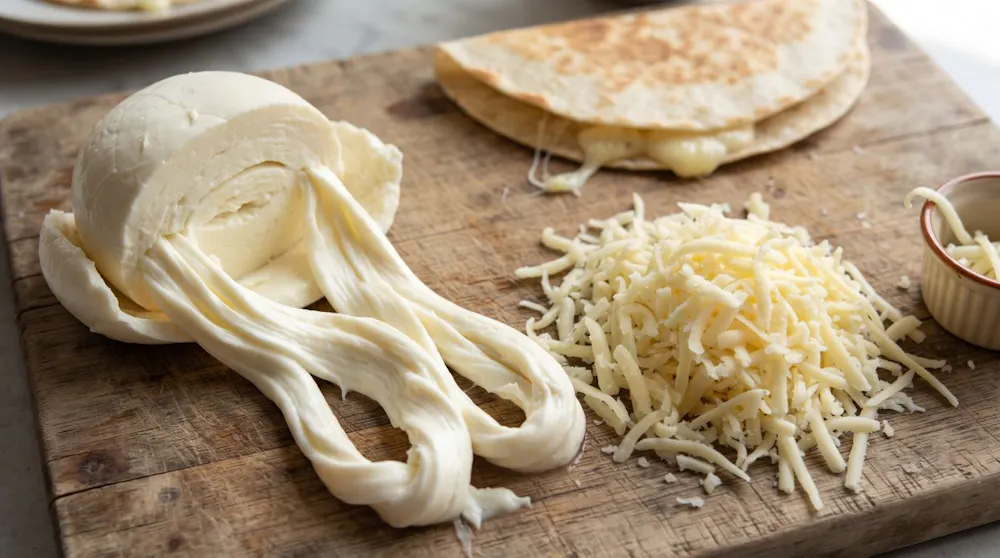
Traditional quesadillas use Oaxaca cheese, a white, semihard Mexican cheese with a stringy, mozzarella-like texture. Picture string cheese that pulls apart in ribbons.
According to Wikipedia's Oaxaca cheese entry, it is similar to unaged Monterey Jack, and the string-cheese method came to Oaxaca with Dominican friars. That is why cooks outside Mexico often grab Monterey Jack: it is the closest everyday cousin.
In northern Mexico, flour-tortilla quesadillas often use Chihuahua cheese, a style made by the Mennonite community. In the Tex-Mex and Southwestern version, cooks usually grate a high-moisture melting cheese such as Monterey Jack, Cheddar, or Colby Jack.
The tortilla and the melted cheese are the constants, and the cheese choice is where Mexican cuisine and its American cousins split.
Taco vs burrito calories: which one has more?
Taco vs burrito calories look close per 100 grams and very different per order. As of Nutrola's June 24, 2026 figures (built on USDA FoodData Central), a beef and bean burrito has 191 kilocalories per 100 grams and a beef taco has 206.
| Per 100 grams | Beef and bean burrito | Beef taco | Cheese quesadilla |
Calories | 191 kcal | 206 kcal | 394 kcal |
Protein | 11.5 g | 9.3 g | 16.9 g |
Fat | 7.5 g | 9.8 g | 25.5 g |
Sodium | 570 mg | 560 mg | 677 mg |
Sources: Nutrola's burrito vs taco, quesadilla vs burrito, and taco vs quesadilla pages, all dated June 2026.
Per 100 grams, the quesadilla is roughly double the burrito. Per order, the burrito often comes out ahead, because the whole thing simply weighs more.
One restaurant chain's published per-item numbers show the effect. A FatSecret listing for Jimboy's Tacos gives a ground beef taco 220 calories, a veggie burrito 500, a bean burrito 530, and a cheese quesadilla 400. Three of those tacos add up to 660, more than one bean burrito.
Treat these as illustrations, not a benchmark for any menu, including ours. If you track calories for health reasons, check the nutrition information from the specific restaurant, and talk to a dietitian for personal advice.
Which should you order: a burrito, a taco, or a quesadilla?
Order based on how hungry you are and how much you want to share. Here is how we'd split it:
Order a burrito if you want a full meal in one hand. Our carne asada burrito, for example, pairs Angus steak with guacamole and salsa fresca.
Order tacos if you like sampling. Our tacos come on soft corn tortillas, with fillings such as carne asada, adobada (marinated pork), pollo asado (grilled chicken), or shrimp.
Order a quesadilla if melted cheese is the point, or if you're splitting something. We make ours with carne asada, adobada, pollo asado, or plain cheese.
We'd say the taco is the best first order for a newcomer, because you can try three fillings for one meal. That's our opinion, not a rule.
Frequently asked questions about burritos, tacos, and quesadillas
Which of the three is the most common street food in Mexico?
Tacos, by a wide margin. The BBQboy guide calls them the most popular food in Mexico, sold from sit-down taquerias and corner stands alike. Quesadillas are a street staple in Mexico City, according to the Skip foodwiki. Burritos are mostly a northern Mexican dish, so you'll find fewer of them farther south.
Can a quesadilla be made without cheese?
In Mexico City, yes. Quesadillas there are not assumed to include cheese unless you ask, a custom Wikipedia says cannot be traced to a single origin. In most of the rest of Mexico, and in nearly every restaurant abroad, a quesadilla without cheese would draw confused looks.
What is the difference between a quesadilla and a sincronizada?
A sincronizada is cheese and ham sandwiched between two flour tortillas, then cooked and cut into wedges. Wikipedia notes that Mexicans do not regard it as a quesadilla, though restaurants abroad often sell it under that name. The ham is the giveaway.
Should tacos use a corn tortilla or a flour tortilla?
Either works, and Mexico splits by region: flour in the north, corn in the south, per the BBQboy guide. Corn is the traditional choice for tacos and the one we use for ours. Burritos are different, since a corn tortilla would crack when rolled, so they need flour.
Are burritos and quesadillas Mexican or Tex-Mex?
Both, depending on the version. Quesadillas originated in colonial Mexico, and burritos in northern Mexico. The oversized, cheese-heavy versions most people eat abroad grew up in the United States, and they fit the Tex-Mex and Southwestern tradition more than central Mexican cooking.
Which is healthier, a burrito, a taco, or a quesadilla?
It depends on fillings, size, and cooking method, so no single answer holds. Mexico News Daily notes that a comal-cooked quesadilla uses no oil, while fried versions are heavier. For personal dietary advice, a registered dietitian can look at your actual goals.
The bottom line: burrito vs taco vs quesadilla in one sentence each
Pick the burrito for a full meal, the taco for a few quick bites, and the quesadilla when melted cheese is the point. All three start with the same humble tortilla, which is what makes the argument so fun.
To taste the difference yourself, find a Blue Burro near you or read how we got started in Long Beach. Menus change, so confirm what's current before you order.
Last updated: October 2026.