
What Is a Burrito? Definition, Origin, Ingredients and Types

What You Need to Know
|
Quick Answer
A burrito is a Mexican and Tex-Mex dish made by wrapping a flour tortilla around fillings like grilled meat, rice and beans, cheese, and salsa, then folding it into a sealed cylinder. It is designed to be eaten by hand, making it a classic handheld meal.
What Does Burrito Mean? The "Little Donkey" Meaning
The burrito meaning is literal: burrito is the Spanish diminutive of burro, translating to little donkey. Why a donkey? The honest answer is that nobody knows for sure, but there are three popular theories:
The pack animal theory: A burrito carries a lot of different things, the way a donkey carries a heavy load.
The bedroll theory: A rolled tortilla looks like the blankets that donkeys once carried.
The schoolchildren theory: A vendor in Ciudad Juárez allegedly called his young customers burritos an affectionate word for slow students and the name moved from the kids to the food.
We find the first theory the most convincing because it matches how a stuffed tortilla actually behaves. Still, that is an opinion, not a documented fact.
Where Did the Burrito Come From? Burrito Origin in Northern Mexico
Burrito origin points to northern Mexico. Ciudad Juárez, in the state of Chihuahua across the border from El Paso, Texas, is the city most often named.
The best-known story credits a street vendorFor a broader look at the dish's historical roots, you can explore the Encyclopædia Britannica Burrito Guide. named Juan Méndez in the Bella Vista neighborhood during the Mexican Revolution (roughly 1910 to 1921). According to legend, he rode a donkey and kept his food warm in large homemade flour tortillas under a small tablecloth.
Treat that story as folklore. Wikipedia's burrito entry notes that most such tales come from the United States, and none is backed by a period document. What the documents do show is older and plainer: a Mexican dictionary of regional words from the 1890s lists burrito as a Guanajuato term for a rolled tortilla with meat inside, the thing Mexico City called a taco.
The sealed flour tortilla version we know today took shape in the north. European colonists there planted wheat and used it for tortillas, helping explain why the flour tortilla is more common in the region. A Mexican food scholar quoted by El Financiero calls the dish thoroughly northern, noting that Larousse Gastronomique lists it as a Ciudad Juárez specialty originally eaten by workers, farmhands, and cowboys.
What Is Burrito History in the United States?
Burrito history in the United States starts in the 1920s and 1930s and speeds up after World War II.
| What Happened | |
| 1923 | Alejandro Borquez opens the Sonora Cafe in Los Angeles, later renamed El Cholo Spanish Cafe |
| 1930s | Burritos appear on American restaurant menus at El Cholo |
| 1934 | A New Mexico regional cookbook by Erna Fergusson gives the burrito its first U.S. media mention |
| 1956 | A frozen burrito is developed in Southern California |
| 1961 | Febronio Ontiveros claims he sold the first retail burrito in San Francisco at El Faro, a Mission District grocery |
| 1970s | Tia Sophia's in Santa Fe claims the first menu item called a breakfast burrito |
| 1980s | The California burrito appears in San Diego taco shops |
As the dish crossed the border, it grew. Today it sits proudly on both Mexican cuisine and Tex-Mex menus, and most burritos sold in the U.S. are bigger and more loaded than anything you would find in Chihuahua.

What Goes in a Burrito? Burrito Ingredients and Burrito Fillings
Burrito ingredients start with a flour tortilla and add a protein, a starch, cheese, and a sauce. The mix changes by region, but these are the foundational building blocks:
Flour tortilla: The wrap, usually warmed on a griddle or comal so it bends without cracking.
Grilled meat: Carne asada (grilled steak), adobada (marinated pork), chicken, shredded beef, or shrimp.
Rice and beans: The filling that gives a burrito its bulk, using whole or refried beans.
Cheese and cream: Melted cheese, sour cream, or crema.
Salsa and toppings: Salsa, pico de gallo, guacamole, lettuce, and tomatoes.
Surprise fillings: French fries in a California burrito, eggs and potatoes at breakfast, or even Korean beef and sushi in Los Angeles.
A good burrito is a balanced bite. The grilled meat brings salt and smoke, the rice and beans bring weight, and the salsa brings the acid that keeps it from feeling heavy. At Blue Burro, our carne asada burrito pairs Angus steak with guacamole and salsa fresca, while our adobada option features marinated pork with guacamole, diced onions, and cilantro.
What Are the Main Types of Burritos?
The types of burritos are named for cities rather than strict recipes. Each style answers a different question about portion size and preparation:
| Style | Where It Comes From | What Defines It |
| Mexican border burrito | Ciudad Juárez and northern Mexico | Small and thin, with one or two fillings |
| Mission burrito | San Francisco Mission District | Large, built on a steam table line, wrapped in foil, with rice and beans, and meat |
California burrito | San Diego | Carne asada, french fries, cheese, and sauces such as sour cream or guacamole |
| Breakfast burrito | New Mexico and Southern California | Eggs, potatoes, cheese, and bacon, sausage, or chorizo |
| Wet burrito | The Southwest (Grand Rapids claims an early version) | Covered in red chile sauce and melted cheese, eaten with a fork |
Chimichanga | Arizona and Sonora | A burrito that is deep-fried |
The Mission burrito deserves a special note. Its assembly line speed and foil wrap made huge burritos practical, and that format later spread nationally through chains like Chipotle Mexican Grill. 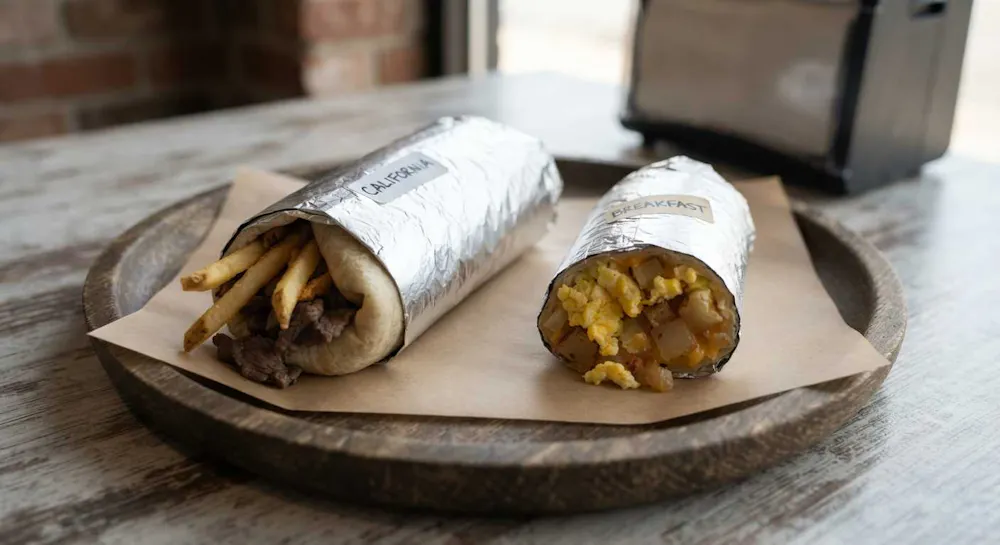
Frequently Asked Questions
Is a burrito a sandwich?
No, at least not in Massachusetts. On October 30, 2006, Judge Jeffrey Locke of Worcester Superior Court ruled in a lease dispute that burritos, tacos, and quesadillas are not commonly understood as sandwiches. The distinction comes down to one wrapped tortilla versus two slices of bread.
Is a burrito Mexican or Tex-Mex?
Both, depending on the version. The dish has roots in northern Mexico, but oversized styles like the Mission burrito grew up in the United States and lean closer to Tex-Mex and Cal-Mex cooking.
Why are burritos in Mexico smaller than American ones?
Traditional Mexican burritos keep things simple, featuring one or two fillings in a thin flour tortilla. Giant exceptions do exist such as a three-kilo burro served at Burros de la 7 in Ciudad Juárez but standard Mexican portions remain compact.
A burrito is a sealed flour tortilla wrapped around hearty fillings, born in northern Mexico and supersized in California. Its name means little donkey, its origin is fiercely debated, and its styles run the gamut from a thin Juárez roll to the massive Mission burrito.
If you want to experience the full range, stop by Blue Burro near you to taste our menu or check out our catering packs for your next group gathering!